Forestry Mulching Services in Spokane, WA
Brush mulching, land clearing, and wildfire fuel reduction — from $1,000/acre. No burning, no hauling, no middleman. Free estimates from a local owner-operator.
What Is Forestry Mulching?
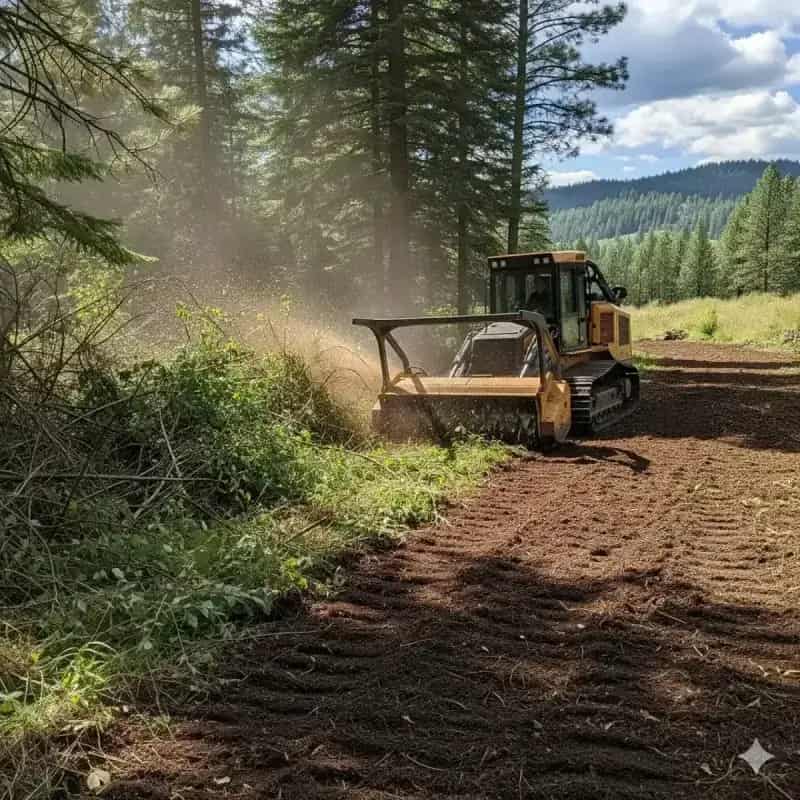
Forestry mulching is a single-pass mechanical method for clearing brush, saplings, and overgrown vegetation. A purpose-built machine with a high-torque rotary drum head and carbide-tipped teeth shreds material directly into a uniform mulch layer on the ground. Most equipment handles stems up to 6–8 inches, with some disc attachments processing up to 14 inches.
Some call it brush mulching or tree mulching — the process is the same. Unlike traditional land clearing services that require separate cutting, piling, hauling, and often burning, forestry mulching consolidates everything into one controlled pass. No burn piles. No hauling trucks. No exposed bare soil.
The processed material stays on-site as a 2–4 inch protective ground cover. It retains moisture, suppresses weed regrowth, and decomposes into organic matter over 12–24 months. This approach is widely used for vegetation management on residential and commercial properties. Our guide on backyard wildfire threats explains why this kind of fuel management matters for Spokane-area properties.
If you're searching for forestry mulching near me in the Spokane area, Gow Forestry brings the equipment directly to your property — no subcontractors, no middleman.
Two primary equipment types handle different conditions: drum mulchers use a cylindrical head with roughly 40 carbide teeth and a 50–75" working width, ideal for 4–9" material and producing a finer mulch finish. Disc mulchers use a rotating disc that handles stems up to 14 inches but produces a coarser output. Both are effective for site prep, vegetation management, and fuel reduction. Tracked carriers offer better stability on slopes and soft ground, while wheeled carriers move faster on flat, accessible terrain.
The result is a single-machine, single-operator, single-pass operation. The mulch layer is managed during operation to maintain a 2–4 inch depth — thick enough to protect soil and suppress weeds, but not so thick it smothers desirable regrowth. Over 12–24 months, the wood chip mulch fully decomposes, contributing organic matter back to the soil.
How Forestry Mulching Works: Our 5-Step Process
Five steps from overgrown brush to defensible space
Free Site Assessment
We walk your property to map vegetation density, slope conditions, access points, and any trees to preserve. You get a clear scope and timeline before any work begins.
Equipment Staging
The mulching carrier is positioned based on terrain — tracked units for slopes and soft ground, wheeled units for flat, accessible lots. Approach paths are planned to minimize ground disturbance.
Selective Mulching
The rotary drum head engages vegetation at controlled feed rates. Healthy trees and natural buffers are retained. Brush, saplings, invasive species, and ladder fuels are processed into mulch on contact — effective fuel reduction in a single pass.
Mulch Distribution
Processed material is distributed as a 2–4 inch ground cover layer. Depth is actively managed during operation — too thick smothers desirable regrowth, too thin leaves soil exposed.
Site Verification
Final walk-through confirms defensible space zones, verifies mulch depth, and documents results. For DNR cost-share projects, we capture before-and-after photography and measurements for reimbursement documentation.
Free Site Assessment
We walk your property to map vegetation density, slope conditions, access points, and any trees to preserve. You get a clear scope and timeline before any work begins.
Equipment Staging
The mulching carrier is positioned based on terrain — tracked units for slopes and soft ground, wheeled units for flat, accessible lots. Approach paths are planned to minimize ground disturbance.
Selective Mulching
The rotary drum head engages vegetation at controlled feed rates. Healthy trees and natural buffers are retained. Brush, saplings, invasive species, and ladder fuels are processed into mulch on contact — effective fuel reduction in a single pass.
Mulch Distribution
Processed material is distributed as a 2–4 inch ground cover layer. Depth is actively managed during operation — too thick smothers desirable regrowth, too thin leaves soil exposed.
Site Verification
Final walk-through confirms defensible space zones, verifies mulch depth, and documents results. For DNR cost-share projects, we capture before-and-after photography and measurements for reimbursement documentation.
Forestry Mulching vs. Burning, Hauling & Dozing
Traditional land clearing services typically involve 3–5 separate operations: cutting, piling, hauling, and often burning. Each step adds time, equipment, labor, and cost. Bulldozing and grading strip topsoil entirely, destroy root systems, and leave bare mineral soil exposed to erosion and weed invasion.
Forestry mulching consolidates all of this into a single controlled pass. The machine processes vegetation on contact. The mulch stays on-site. The ground surface is left intact — an effective approach to fire prevention and land management. Compare the methods below, or learn more about our lot clearing services.
Get a Free Forestry Mulching Estimate
Talk directly with the local operator — no sales team, no call center.
After Forestry Mulching: The Science of Soil Recovery
Forestry mulching doesn't just clear brush — it actively improves soil health. Here's what peer-reviewed research shows.
47%
Average reduction in surface water runoff from mulched sites
Global meta-analysis of 421 observations across 90 published studies
76%
Average reduction in soil loss on mulched sites vs. bare soil
Same meta-analysis, 512 soil loss observations
60%
Minimum mulch ground coverage needed for effective erosion control
Achieving ~50% runoff reduction and ~80% soil loss reduction
12–24 mo
Decomposition timeline for wood chip mulch to contribute organic matter back to soil
How the Mulch Layer Works
Raindrop Impact Absorption
The mulch layer absorbs kinetic energy from rainfall, preventing soil particles from being dislodged and carried away.
Infiltration Enhancement
Organic mulch improves soil porosity and structure over time, increasing the rate at which water penetrates the surface rather than running off.
Surface Water Storage
The mulch creates micro-detention areas that temporarily hold water, giving it time to infiltrate rather than flow downhill.
Runoff Velocity Reduction
Physical friction from the mulch surface slows water movement across the ground, reducing its erosive force.
Soil Structure Improvement
As mulch decomposes, it contributes organic matter that improves soil aggregation — binding soil particles into stable clumps that resist erosion.
Biological Activity
The mulch layer creates favorable conditions for earthworm activity, fungal networks, and microbial communities that strengthen soil bonds and cycle nutrients.
Soil carbon note: Research shows organic mulching increases soil organic carbon — compost applications by ~6.8%, chipped wood by ~2%. This matters because higher soil carbon improves water retention, nutrient availability, and long-term site productivity.
Why Spokane Properties Need Forestry Mulching Services
The Fire Suppression Problem
Over a century of fire suppression across Eastern Washington has created forest density 3–4× historical levels. Ponderosa pine stands that once grew with 20–40 feet of spacing between trees — maintained by natural, low-intensity fire cycles every 5–10 years — now have trees packed 5–10 feet apart (USFS Ponderosa Pine Ecology & Management). This overstocking creates continuous fuel ladders from ground to canopy, turning what would have been manageable surface fires into the intense, structure-threatening crown fires that increasingly affect Spokane-area communities. Our detailed guide on backyard wildfire threats covers the cascading risks.
Local Species Context
The dominant tree species in the Spokane region — ponderosa pine, interior Douglas-fir, western larch, and grand fir — evolved under frequent fire regimes. Ponderosa pine in particular developed thick, plated bark and self-pruning behavior specifically adapted to survive low-intensity surface fires. But when understory brush and ladder fuels aren't managed, those adaptations can't protect the trees from the high-intensity fires that overstocked conditions produce.
Brush Clearing & Vegetation Management for Eastern Washington
Forestry mulching restores healthier stand spacing by selectively removing ladder fuels and understory brush. Root systems stay intact. Eastern Washington's thin, erosion-prone soils stay in place. The result is effective fire prevention without the collateral damage of bulldozing or burning.
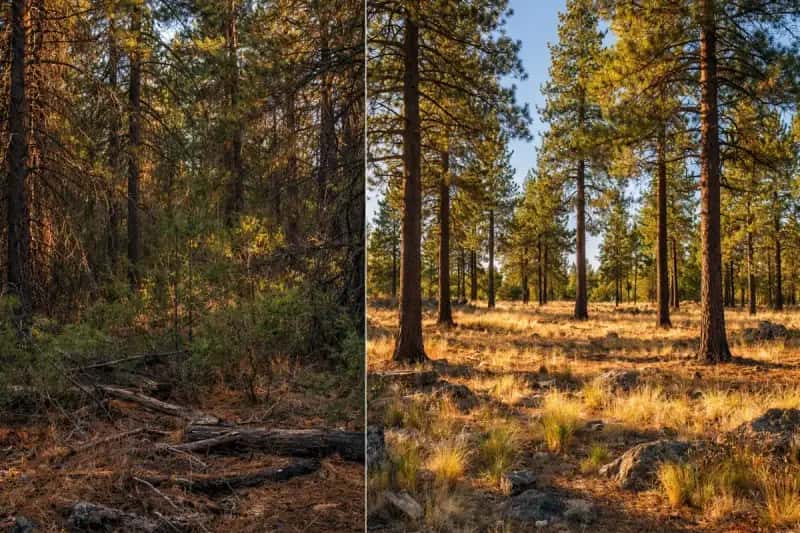
Forestry mulching before and after results speak for themselves — dense, overgrown stands become open, manageable properties with clear sightlines and reduced fire risk. For properties in Spokane, Spokane Valley, and Liberty Lake — where the wildland-urban interface puts homes directly adjacent to overstocked forest — this work directly reduces the intensity and spread potential of wildfire reaching structures. Learn more about our defensible space creation services. Many of these projects qualify for Washington's DNR cost-share program, which can reimburse up to 50% of approved treatment costs.
Defensible Space Creation with Forestry Mulching
The NFPA 3-zone model defines how to manage vegetation around structures. Forestry mulching is the most efficient method for vegetation management in Zones 1 and 2. Hover or tap each zone to see what's required.
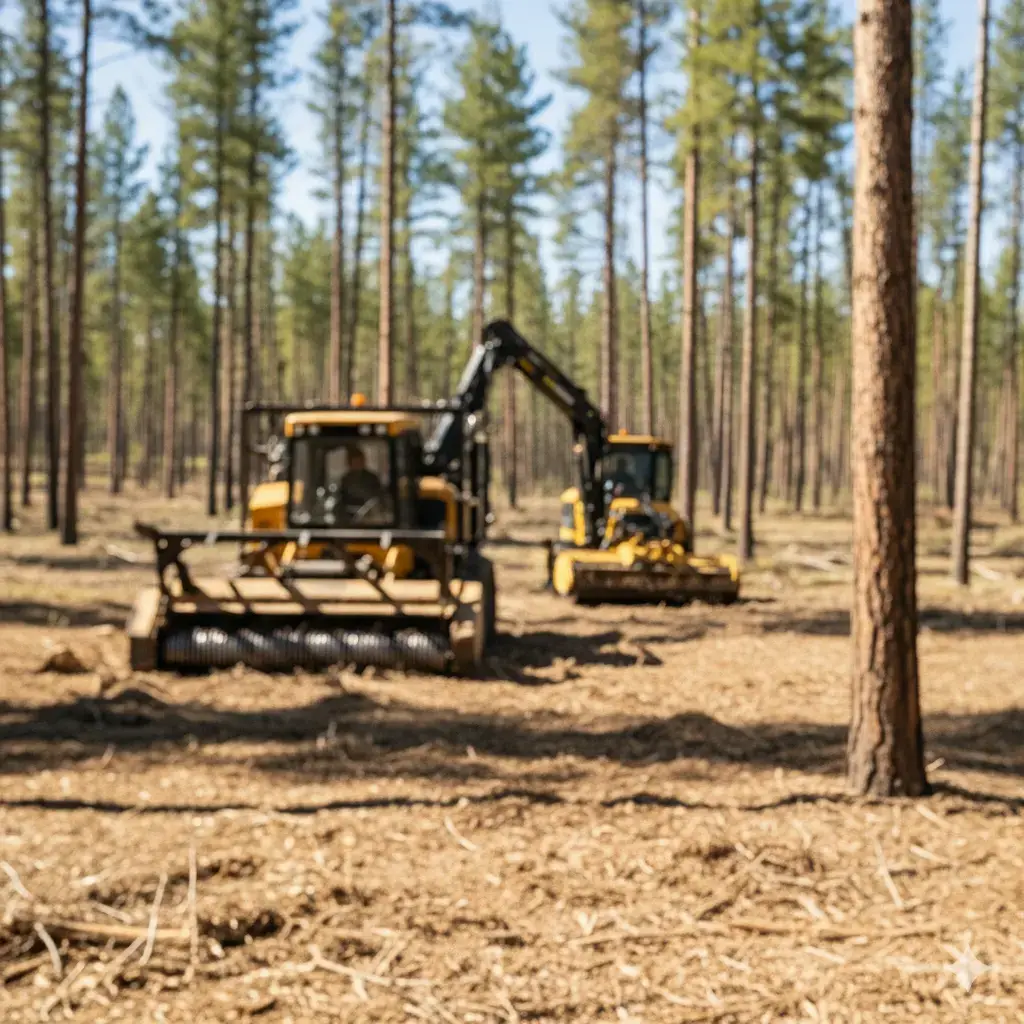
Defensible space creation starts with Zones 1 and 2 — forestry mulching removes ladder fuels and understory brush while preserving healthy mature trees. Learn more about our defensible space creation services.
Forestry Mulching Applications in Spokane
From brush clearing and site prep to wildfire fuel reduction, forestry mulching handles a wide range of land management needs in a single pass.
Residential Defensible Space
Clear the brush and ladder fuels around your home to meet defensible space guidelines. One pass creates the clearance you need without displacing topsoil or killing your mature trees. Ideal for properties in the Spokane wildland-urban interface.
Defensible space servicesLot Clearing for Development
Prepare overgrown or raw lots for construction, sale, or permitted use. Forestry mulching handles the vegetation and site prep in a single operation, leaving a stable surface ready for the next phase — without the hauling and disposal costs of traditional clearing.
Lot clearing servicesWildfire Fuel Load Reduction
Reduce hazardous fuel loads by eliminating the understory brush and dead material that allow surface fires to climb into tree canopies. This is the core of fire prevention — breaking the vertical and horizontal fuel continuity that drives fire intensity.
Invasive Species Management
Mechanically control invasive brush species — blackberries, Russian olive, red cedar encroachment — through vegetation management without chemical herbicides. The mulch layer suppresses invasive seed germination while providing a nutrient-rich seedbed for native species to reestablish.
Trail, Driveway & Access Clearing
Open up overgrown trails, driveway margins, and access roads. Forestry mulching handles the brush while leaving a clean, stable surface — no grading or gravel needed in most cases.
DNR Cost-Share Eligible Projects
Many wildfire mitigation and forest health projects in Washington qualify for DNR cost-share assistance — potentially covering up to 50% of treatment costs. We help eligible landowners navigate the application and documentation process.
DNR cost-share assistanceYour forestry mulching cost could drop 50% with state funding
Washington's DNR cost-share program reimburses landowners for forestry mulching services including brush clearing, defensible space creation, and fuel reduction. Kevin handles the paperwork.
Service Areas
Gow Forestry provides brush mulching, land clearing services, and defensible space creation across the greater Spokane region — from Spokane Valley and Liberty Lake east to the Idaho border, and north through Mead, Deer Park, and Chattaroy to Newport. Whether you need defensible space around a home in Spokane, lot clearing in Liberty Lake, or wildfire fuel reduction on acreage in Spokane Valley, we bring the same equipment and expertise to every job.
Frequently Asked Questions
What is forestry mulching?+
How is mulching better than burning or hauling?+
Can I get government funding for forestry mulching in Washington?+
How fast is the process?+
Do I need permits?+
What happens to the mulch afterward?+
Is stump removal included?+
How much does forestry mulching cost in Spokane?+
How many acres can a forestry mulcher clear in a day?+
Is forestry mulching better than burning?+
Does forestry mulching prevent erosion?+
What's the difference between forestry mulching and land clearing?+
Can forestry mulching handle large trees?+
How do I get a free estimate for forestry mulching in Spokane?+
Get a Free Forestry Mulching Quote in Spokane
Get a free estimate, a clear plan, and a clean finish that improves defensible space fast.